Supplier emissions
software for Scope 3
Collecting supplier emission data manually is slow, inconsistent and hard to audit. CarbonTool structures the request, the collection and the calculation, so your Scope 3 Category 1 inventory is traceable from day one.

Supplier mapped
12.4 tCO₂e








Intuitive workflow
Create your supplier list. Connect it to your emissions
Add suppliers manually or import them from existing financial and carbon data.
Link suppliers to emission entries so CarbonTool can understand who contributes to your footprint.
Keep supplier names, VAT IDs and company details structured in one place, ready for engagement.
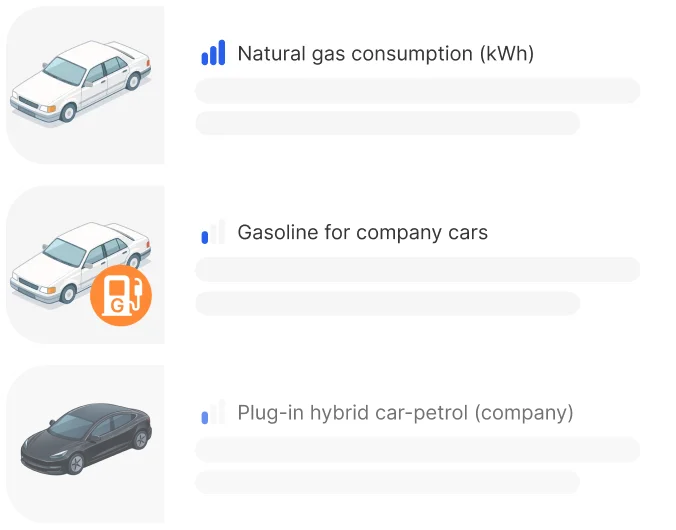
Focus on the suppliers that matter most.
See which suppliers contribute most to your carbon footprint, ranked by actual emissions data.
Set a relevance threshold so the platform identifies the suppliers that should be engaged first.
Choose the right questionnaire depth based on each supplier’s contribution, from light screening to full ESG assessment.
Target
Across
Emissions by Month
Send the right request. Track every response.
Invite suppliers directly from the platform by email or share a secure questionnaire link.
Suppliers receive a guided questionnaire adapted to their level of relevance and data maturity.
Track invitation status, completion progress and missing responses without managing everything manually.

Digital invoicing / paperless office
3 | Purchased goods & services
Process water recirculation
3 | Capital GoodsTotal Savings
Duration 0 months
Budget 0 EUR
Answer supplier requests. Reuse your data.
Receive questionnaires from clients and manage them inside the same platform.
Complete your supplier profile, carbon data and ESG information once, then reuse it for future requests.
Monitor progress, update answers and keep your supplier information ready when the next request comes in.
Emissions by Month
Scope 1
0tCO2e
9.5% increase
Scope 3
0,0tCO2e
24% decrease
Five ways to import data
Five ways to get your emission data into CarbonTool. Start with one, add more as your process matures.
Collect: Suppliers Need No Carbon Software
Import your supplier list and send structured data requests directly from CarbonTool. Suppliers submit activity data such as energy consumption, material volumes, transport records through a guided form that requires no carbon accounting expertise on their side. Where suppliers cannot provide data, spend-based proxies maintain inventory completeness automatically.
Why companies choose CarbonTool

Verified emissions reduction
1,204,312 tCO₂e
Stay compliant
Meet CSRD, VSME, GRI, and CDP requirements on the same data backbone. Structure your data once, report across every framework without duplicate entry.
Cut costs
Starting at €2,000/year with unlimited users. No per-seat fees, no implementation consultants. Where most platforms charge €20,000–50,000+, CarbonTool gives you the same capabilities at a fraction.
Market advantage
Customers, investors, and regulators increasingly require emission data. Companies that measure early build credibility — and avoid the rush when reporting becomes mandatory.
Centralize all data
One platform for all scopes, all business units, all reporting periods. Replace scattered spreadsheets with a single data backbone that feeds your footprint, targets, scenarios, and reports.
Got more questions?
Can't find what you're looking for? Check the FAQs below, or reach out and we'll get back to you within one business day.
Where suppliers cannot provide activity data, CarbonTool applies spend-based or physical-unit proxy factors by supplier category and geography. These maintain Scope 3 Category 1 inventory completeness while primary data collection is in progress. As suppliers submit actual data, the inventory shifts from proxies to verified figures and PCAF data quality scores improve accordingly. The platform tracks this progression across your entire supplier portfolio.
Yes. CarbonTool provides a structured supplier data request workflow that guides suppliers through submitting activity data such as energy consumption, transport records, material volumes, without requiring any carbon accounting expertise or software on their side. The platform applies the correct methodology and emission factors to their inputs automatically. Suppliers need only provide the underlying operational data, not a calculated footprint.
Supplier emissions collected through CarbonTool feed directly into your CSRD Scope 3 Category 1 disclosure from the same data backbone. No duplicate entry, no manual transfer between systems. Every supplier data point is traceable back to its source submission, with the emission factor, methodology and data quality score recorded. This is the level of traceability statutory auditors require to verify your sustainability statement.
PCAF (Partnership for Carbon Accounting Financials) defines a data quality scoring framework from 1 to 5, where 1 means verified primary data from the supplier and 5 means a spend-based proxy with no supplier input. The score matters because CSRD and investor ESG frameworks increasingly require disclosure of data quality alongside the emissions figure itself. CarbonTool assigns and tracks PCAF scores across your supplier portfolio so you can demonstrate data quality improvement over time, not just a static emissions number.
Spend-based Scope 3 estimates emissions from money spent with a supplier, using industry-average factors. Activity-based Scope 3 uses the supplier's actual operational data (energy, materials, transport), producing a more accurate, defensible figure. CarbonTool starts with spend-based proxies for completeness and upgrades suppliers to activity-based data as they respond.
Gain Sustainability Insights
Scope 3 Category 1 is your largest liability.
Start with the data .
Companies facing CSRD obligations or buyer sustainability requirements need supplier emission data that is traceable, methodology-backed and audit-ready. CarbonTool gives you the structure to collect it, without consultant dependency or manual rebuilds each reporting cycle.