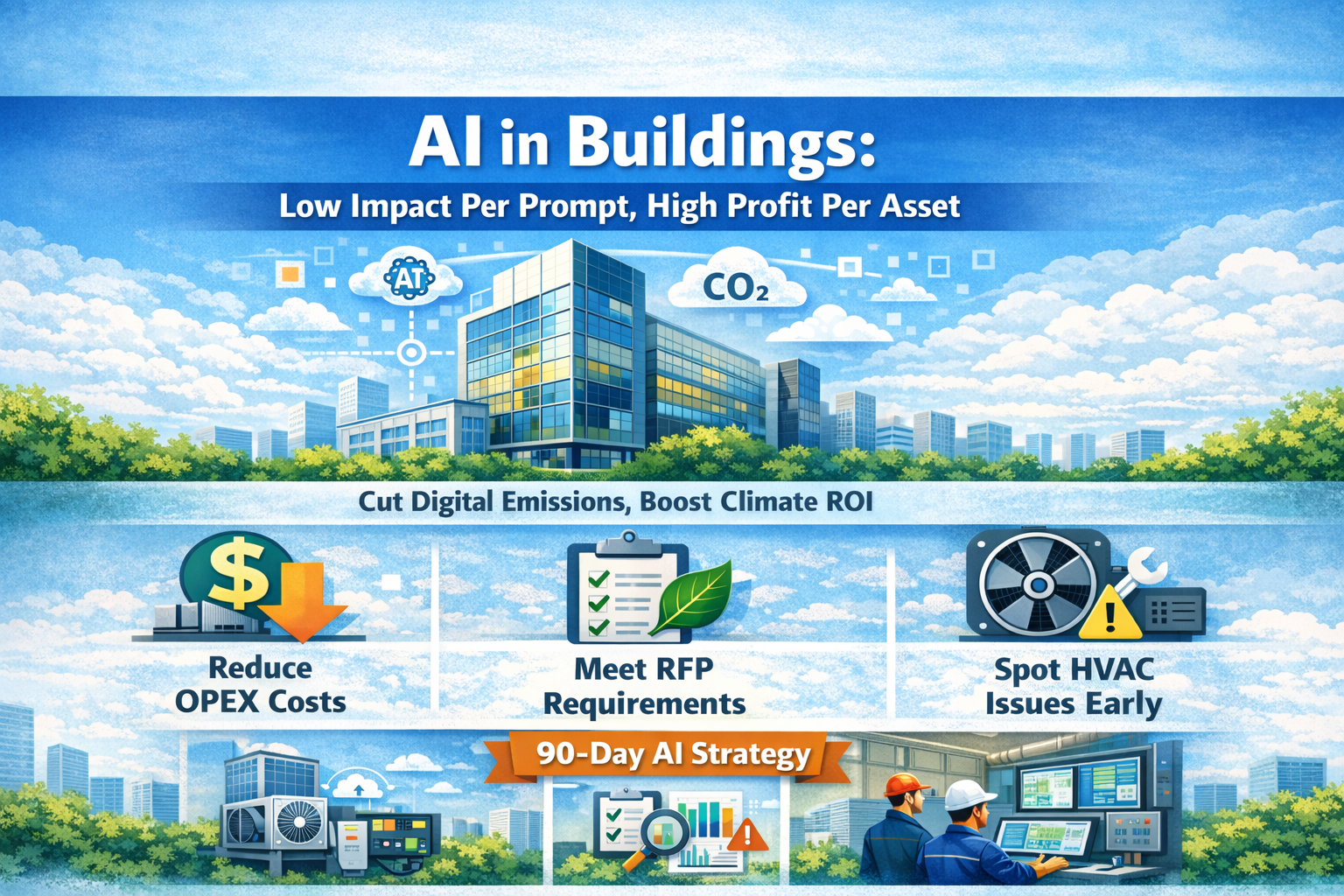
AI in Buildings: Low impact per prompt, high profit per asset
Reading
4 min total
0%
AI is becoming critical infrastructure and digital emissions are entering Scope 3. Here’s how to use AI in buildings for climate ROI to lower OPEX, meet RFP requirements and help maintenance teams spot HVAC issues early.
Artificial Intelligence has moved past “innovation theater.” In 2026, it’s infrastructure, embedded in workflows, procurement and operations. At the same time, digital emissions (from cloud use, data processing and AI workloads) are increasingly discussed under Scope 3.
The winning model is “human in the loop.” AI insights don’t create value on their own, they only become Climate ROI when every alert has clear ownership, a decision path and a measurable outcome. In practice, that means linking each insight to a named responsible role (FM lead, BMS engineer, HVAC contractor), a response time and a simple impact metric such as energy cost avoided, emergency callouts prevented or runtime reduced.
With that in mind, the real question for building owners and operators is simple:
What does “Climate ROI” look like and how do you get it in 90 days?
Digital emissions are real. So is the opportunity.
Yes, AI workloads consume energy. If you’re tracking emissions seriously, you should treat key digital services like any other input: measure, allocate and optimize.
The bigger story, though, is what AI can unlock on the physical side: lower energy use, fewer emergencies and better proof of performance, especially in complex systems like HVAC.
What management actually wants (and why it matters)
From a leadership perspective, AI is valuable when it delivers two outcomes:
- Cost reduction (OPEX)
If AI helps detect inefficiencies early in respects such as poor schedules, drifting setpoints, simultaneous heating/cooling, it turns invisible waste into measurable savings. - Compliance and competitiveness in RFPs
More tenant and investor questionnaires now ask for operational proof in fields including energy performance, monitoring, reporting cadence and continuous improvement. AI becomes a lever to deliver that proof faster.
What operational teams need (and what AI should do)
AI in buildings is not about replacing technicians. It’s about making their work more predictable and less reactive.
In the field, value shows up when AI can flag abnormal HVAC behavior before comfort complaints begin, energy losses (e.g., stuck valves, failing sensors, poor control logic), patterns that indicate “this will become critical in two weeks.”
Instead of sending people on emergency callouts, AI helps teams prioritize the right intervention at the right time, saving effort, downtime, and cost.
The 90-day plan (simplified)
You don’t need a perfect system to start. You need a focused pilot, clear measurement and a feedback loop
.
1) Mapping: identify the biggest consumers
Map the assets and workloads that matter most:
- Physical: HVAC systems, major equipment, control layers (BMS), metering coverage
- Digital: cloud platforms, data pipelines, dashboards, AI services
The goal is not a full inventory. It’s to find the top drivers of kWh and operational challenges. And be sure to add one more mapping layer, who owns what. If a system has no owner, it will not improve, no matter how smart the analytics are.
2) Transparency: demand real data, not estimates
Ask vendors and internal teams for clarity:
- What data sources are used (meters, BMS points, invoices)?
- How often is data updated?
- What assumptions are made?
- Can results be reproduced and audited?
Transparency is what turns AI insights into decision-grade outputs. Also demand transparency in responsibility. Establish what happens after an alert and who approves changes.
3) Pilot: choose one large building
Pick a single high-impact asset:
- large office, retail, logistics, hospital or campus building
- already has partial metering and BMS data, even if imperfect
Measure kWh and tCO₂ before and after. If AI optimizes HVAC:
- the technical team sees fewer urgent interventions,
- management sees lower OPEX and stronger proof for stakeholders.
Build the pilot as a closed decision loop so insights lead to action and action leads to measurable savings. Define 10–20 alert types that trigger a specific response and assign a clear owner to each one. Close the loop by logging the decision, the intervention and the result in plain metrics such as runtime reduced, comfort incidents avoided, emergency visits prevented and energy cost lowered.
If you want AI to deliver Climate ROI, don’t start with a company-wide transformation. Start with one pilot that proves savings and funds the next one.
Gain Sustainability Insights
Stay informed
Press releases and company announcements delivered directly to your inbox. No marketing emails.
Ready to turn carbon data
Join the companies using CarbonTool to measure emissions, manage risk, and report with confidence. Start free. No credit card, no sales call.