How the GHG Protocol Land Sector and Removals Standard Will Change Real Estate Climate Reporting
Reading
4 min total
0%
Land-related emissions and carbon removals have long been treated inconsistently in corporate climate reporting. In many cases, land-use impacts were simplified, assumed neutral, or used to support climate claims without sufficient transparency.
With the release of the GHG Protocol Land Sector and Removals Standard Version 1.0, effective from January 1, 2027, that approach is changing. The new framework introduces clearer boundaries between emissions and removals, strengthens reporting requirements, and raises the bar for climate claims.
While the standard is often associated with agriculture, its implications extend far beyond that sector. Real estate is one of the most directly affected industries, because every development involves land use change, and land use change is no longer climate neutral by default.
A Structural Shift in Land Accounting
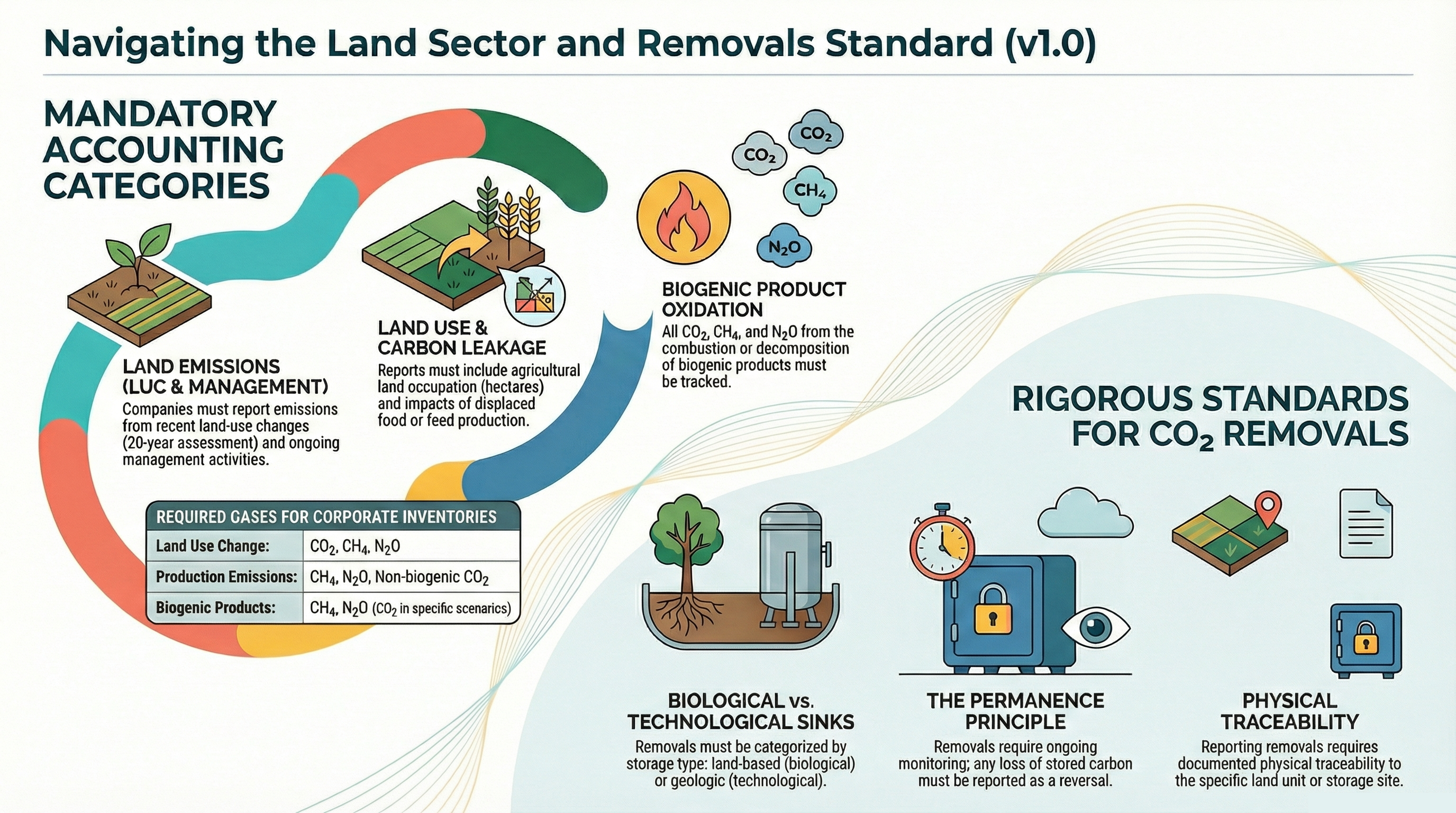
Version 1.0 focuses on agricultural land management practices and engineered CO₂ removal technologies such as direct air capture. Forestry is intentionally excluded from this first release, as further methodological development is required before it can be robustly integrated into corporate inventories.
Beyond scope definitions, the standard represents a deeper shift in climate accounting logic. Land plays a dual role in the climate system: it can generate emissions through land-use change and soil disturbance, but it can also remove carbon from the atmosphere.
Until now, these impacts were often blended together. Emissions from land conversion were sometimes overlooked, while removals were presented alongside emission reductions without clear separation. In some cases, temporary carbon storage was communicated as if it delivered permanent climate benefits.
The new framework introduces a clear principle:
gross emissions must be reported in full, and removals must be disclosed separately.
Carbon removals do not reduce Scope 1, Scope 2, or Scope 3 emissions. They are reported independently, supported by transparent methodologies, and assessed based on durability and permanence.
Permanence and the Limits of Removals
A central element of the standard is permanence. Carbon stored in soils or biological systems may be released due to wildfire, drought, pests, or land-use change. Companies must therefore disclose how long carbon is expected to remain stored and how reversal risks are managed.
- Temporary storage cannot be presented as a permanent climate solution.
- The standard also distinguishes between nature-based and technology-based removals, recognizing that they differ significantly in durability and risk. This prevents removals from being treated as automatically equivalent, even when the volume of CO₂ appears similar.
Why Real Estate Is Particularly Impacted

For real estate developers and construction companies, the implications are immediate.
When land is converted from a natural or semi-natural state into a built environment, it typically results in:
- loss of carbon stored in vegetation and soils
- long-term land sealing
- reduced future sequestration potential
Under the new standard, these impacts are recognized as real and reportable emissions, regardless of whether the project is energy efficient or legally compliant.
Legality does not equal climate neutrality.
This challenges a long-standing assumption in the market: that high-performing or certified buildings can automatically support carbon neutral claims.
Green Buildings Are Not Automatically Carbon Neutral
Green roofs, landscaping, and tree planting remain valuable for biodiversity, urban resilience, and wellbeing. However, the standard makes clear that most landscaping measures do not qualify as carbon removals.
Common limitations include lack of additionality, limited storage duration, and difficulties in monitoring permanence. These measures improve environmental performance, but they do not cancel construction or operational emissions.
The era of default “carbon neutral buildings” is coming to an end. Going forward:
- emissions are reported gross
- removals are disclosed separately
- offsets are reserved for residual emissions, typically at portfolio level
A building can be low carbon without being carbon free.
What This Means for Companies Preparing for 2027
The Land Sector and Removals Standard represents a move toward more science-based and transparent land accounting. Its implications extend beyond agriculture and directly affect any organization that:
- owns or develops land
- changes land use
- relies on nature-based solutions
- communicates net-zero or carbon-neutral targets
For developers and investors, this means prioritizing brownfield redevelopment where possible, reducing embodied and operational emissions first, and applying caution in climate-related claims.
In this evolving landscape, both strategic guidance and robust data systems are essential.
BuildGreen supports real estate and corporate clients by integrating these emerging requirements into ESG strategies, climate risk assessments, and sustainability frameworks, ensuring that development decisions align with evolving reporting standards.
At the same time, CarbonTool provides the digital infrastructure needed for structured, transparent, and traceable carbon accounting. The separation of gross emissions from removals, documentation of land-use change impacts, and support for credible climate claims become critical as scrutiny increases.
Together, strategic expertise and reliable data management enable companies not only to comply with the 2027 implementation, but to strengthen the credibility of their climate strategies today.
The Land Sector and Removals Standard does more than adjust reporting methodology. It reshapes how land is understood within corporate climate strategies. As scrutiny intensifies and transparency becomes non-negotiable, early preparation will distinguish credible climate leaders from those relying on outdated assumptions.
2027 may mark the formal implementation, but the strategic transition starts now.
Gain Sustainability Insights
Stay informed
Press releases and company announcements delivered directly to your inbox. No marketing emails.
Ready to turn carbon data
Join the companies using CarbonTool to measure emissions, manage risk, and report with confidence. Start free. No credit card, no sales call.