Upcycling PVC Ads Cuts Emissions by 85 Percent
Reading
3 min total
0%
Outdoor advertising is expanding across Romania and the wider region, but so is the footprint behind every campaign: materials, printing, logistics and end-of-life. As the media market grows and Out-of-Home (OOH) investment rises, the industry faces a practical question. How do we cut emissions at scale without slowing delivery timelines or limiting creative options?
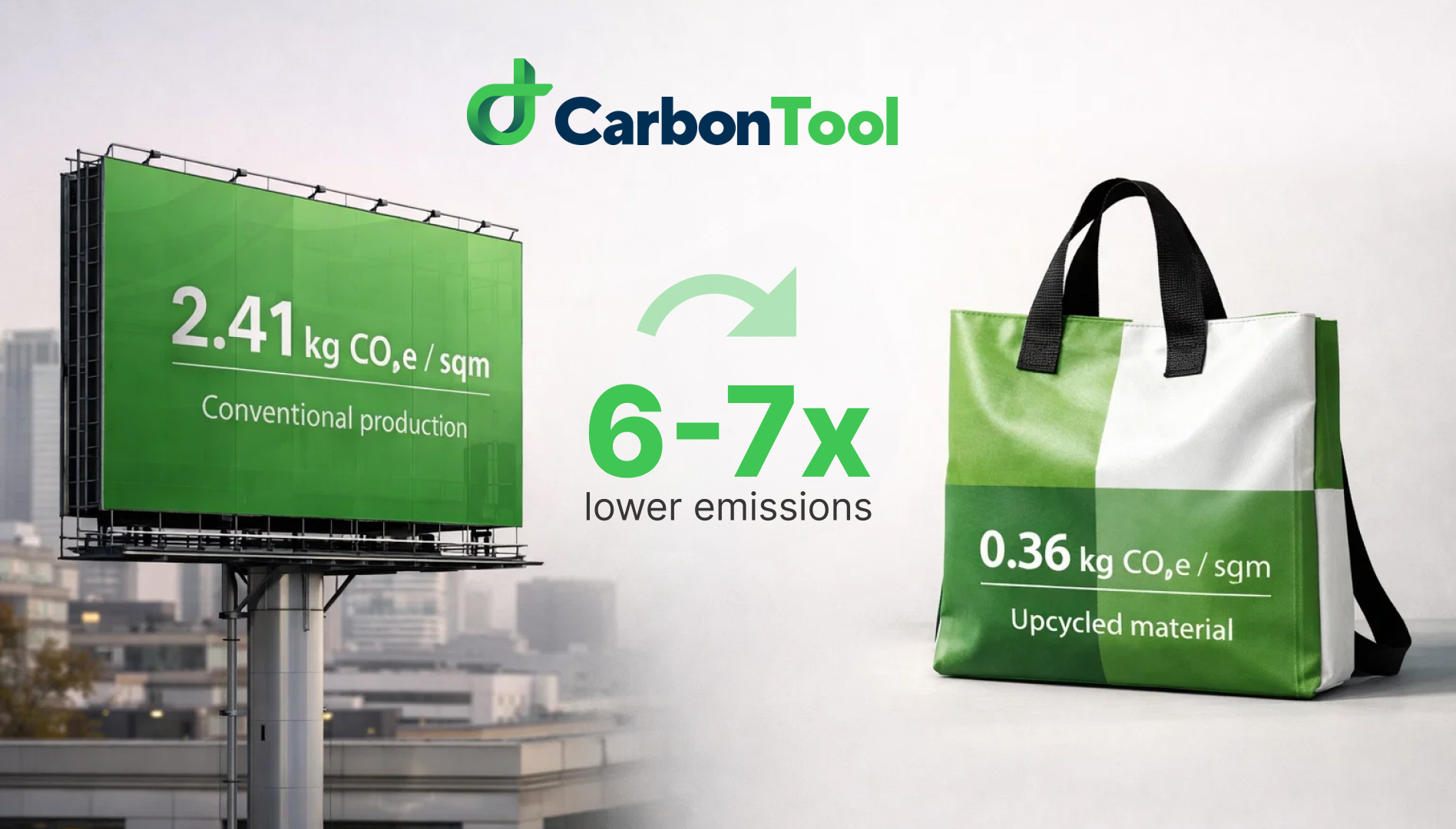
The result: 6–7x lower emissions
A comparative analysis by CarbonTool, part of the BuildGreen ecosystem, and Ateliere Fără Frontiere, through its remesh workshop, offers a data-backed answer. Reusing PVC mesh and banners through upcycling can reduce greenhouse gas emissions by around 6-7 times compared to a conventional production model.
To make the comparison fair and repeatable, results are reported per 1 sqm of PVC advertising material using life-cycle assessment principles. The conventional scenario reaches 2.41 kg CO₂e/sqm, while the upcycled option reaches 0.36 kg CO₂e/sqm, an approximate 85% reduction.
Raw materials: The 63% hotspot
The most important insight is where emissions come from in the first place. In the conventional product scenario, raw materials contribute 1.53 kg CO₂e/m²—about 63% of the total footprint. In other words, the dominant decarbonization lever isn’t marginal efficiency in production; it’s reducing dependence on virgin inputs.
This is exactly what the remesh upcycling model changes. Used advertising banners and mesh become the base material for new functional products such as bags, backpacks, wallets, tote bags, accessories, and customized promotional items. Only small auxiliary components—zippers, thread, and fastening elements—are added. Because the material is already printed, the printing stage can be eliminated for the base material, removing a major source of emissions and resource use in the conventional pathway.
Transport, higher, but not a deal-breaker
Logistics is one area where upcycling can increase emissions. Transport is higher in the upcycling scenario (0.16 kg CO₂e/m²) compared to the conventional scenario (0.09 kg CO₂e/m²), driven by collection from multiple locations and additional flows. However, the absolute contribution remains limited—and it is more than offset by the savings achieved by avoiding virgin PVC production and eliminating printing. In practice, collection can also be optimized by picking up banners in parallel with other waste streams, reducing dedicated trips.
For advertisers, agencies, and brands, the value of this approach is that it’s measurable, reportable, and scalable. Carbon footprint reduction data can be integrated directly into ESG reporting, decarbonization strategies, and stakeholder communications—starting with everyday purchasing decisions like promotional items and campaign materials.
The takeaway is simple: if you want credible emissions reductions, start where the impact is biggest, and that is with materials. Measure emissions in comparable units (like per m²), target the raw-material hotspot, and replace linear procurement with circular sourcing wherever feasible. Sometimes, the fastest wins don’t come from reinventing the campaign, they come from redesigning what happens after it ends.
Gain Sustainability Insights
Stay informed
Press releases and company announcements delivered directly to your inbox. No marketing emails.
Ready to turn carbon data
Join the companies using CarbonTool to measure emissions, manage risk, and report with confidence. Start free. No credit card, no sales call.