ZF ESG Summit. What it takes to reach decarbonisation
Reading
4 min total
0%
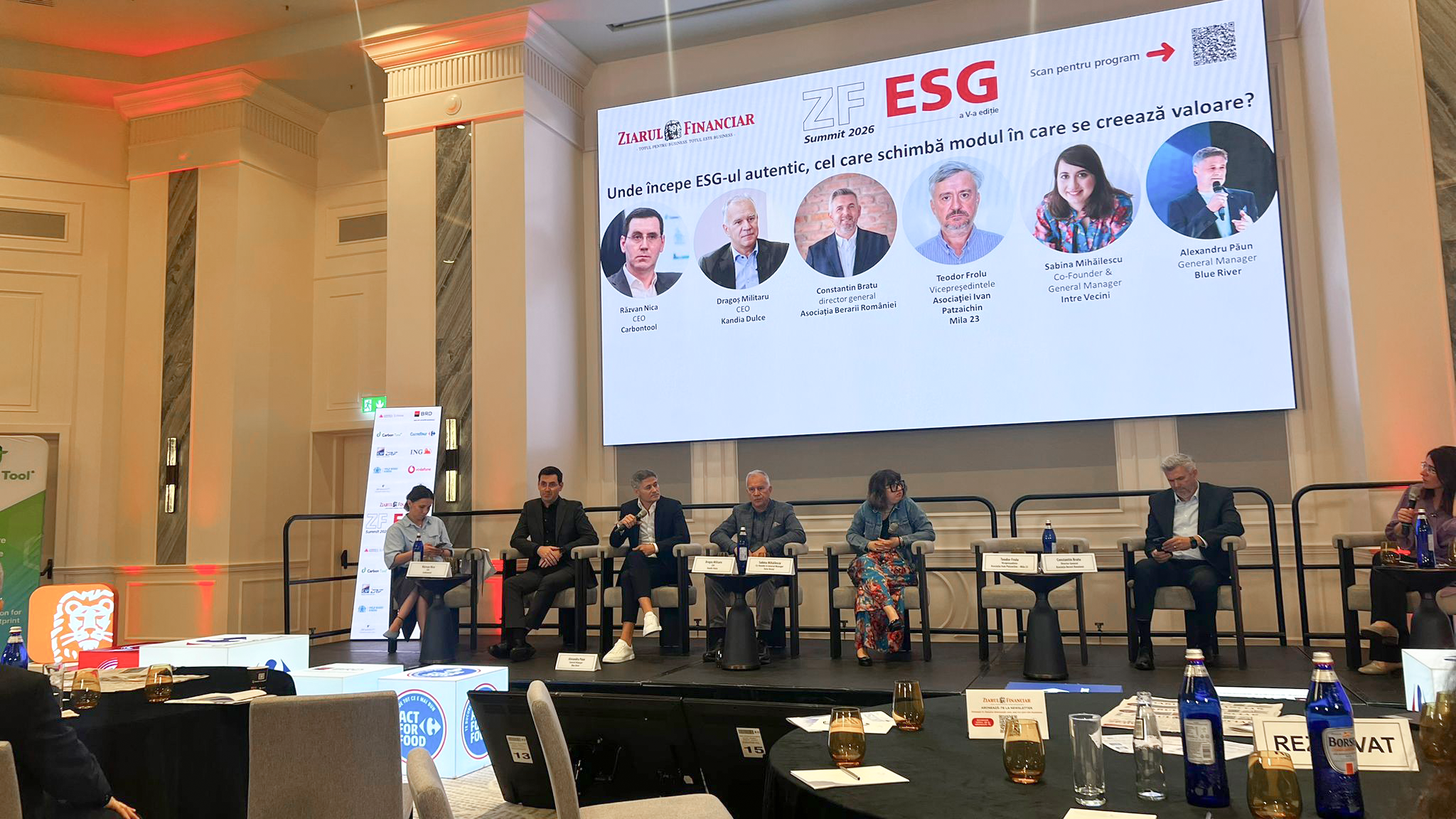
On May 12, CarbonTool founder and CEO Răzvan Nica took the stage at the ZF ESG Summit 2026 as part of a panel asking one of the most important questions in corporate ESG today. Where does authentic ESG begin, the kind that genuinely changes the way value is created?
Held at the JW Marriott Bucharest, the panel brought together leaders from various industries. The cross-sector composition made the conversation especially relevant, as the ESG data challenge is not a real estate problem or a manufacturing problem. It is a structural challenge that cuts across every industry serious about decarbonisation.
Authentic ESG as an operational question
Răzvan Nica's first point was definitional and direct. Authentic ESG begins when it stops being a PR exercise and becomes embedded in management, operations and business efficiency. "Companies are built with a long-term horizon," he said, "which by definition requires an ESG component to be incorporated, not added on top."
The distinction matters because it reframes where the work actually begins. Not in the communications department, and not in the sustainability report. In the data.
The problem CarbonTool was built to solve
Răzvan Nica gave the clearest articulation yet of the core challenge that led to CarbonTool's development. After more than a decade of working on building sustainability and carbon footprint management, the pattern was consistent. Organisations had the data needed to understand and reduce their carbon footprint, but it was scattered.
"The data is dispersed across departments, in invoices, ERP systems, energy reports, procurement. The barrier is not that data doesn't exist. The barrier is collection and unified management."
CarbonTool was designed precisely to centralise data that already exists within an organisation, structure it against internationally recognised standards and produce outputs that support actual business decisions, such as carbon footprint per unit of product, per kilometre travelled, per item sold. Metrics that can be tracked, benchmarked and improved.
The platform also uses AI to extract data from diverse document formats, removing one of the most time-consuming manual steps in carbon accounting and making the process scalable across organisations of different sizes and sectors.
The supply chain is becoming a reporting framework
One of Răzvan Nica's most practically significant observations concerned the mechanism driving ESG data adoption beyond directly regulated companies. Major retailers and buyers, and he referenced examples from the food and logistics sectors, are already requesting carbon footprint data from their suppliers as a condition of doing business.
"Reporting standards have been adopted by the supply chain", Răzvan Nica explained. "Suppliers are being asked for this information by their buyers, so the need to collect and calculate carbon footprint data transfers across the entire supply chain."
This means that for many organisations, the question of whether to begin measuring is no longer theoretical. The pressure is already arriving through commercial relationships, ahead of formal regulatory requirements.
Where you stand and where you're going
A consistent request from clients over nearly 20 years is that not just the number matters, but context. CarbonTool's benchmarking layer addresses this by showing organisations where they stand relative to industry peers, thus enabling meaningful target-setting rather than abstract ambition.
The progression Răzvan Nica described is practical. Start by reaching or approaching the industry average, then align targets with client requirements or applicable international standards, then build out a decarbonisation plan with emissions scenarios over a longer horizon.
Why historical data matters
Răzvan Nica closed the panel with a challenge that is underappreciated until organisations are well into their decarbonisation journey, namelu that the depth of historical data shapes the quality of every forecast.
"With data from only one year, it's insufficient to understand the dynamics," he said. Reliable predictions on energy consumption, the influence of external temperature variations, the effects of technology changes require at minimum four to six years of operational history. The longer the data series, the smaller the margin of error, and the more credible the decarbonisation plan.
The implication for organisations starting now is to begin collecting, structuring and storing data today, because the value of that data compounds over time. The organisations that will make the most confident decarbonisation commitments in three years are the ones measuring carefully right now.
Gain Sustainability Insights
Stay informed
Press releases and company announcements delivered directly to your inbox. No marketing emails.
Ready to turn carbon data
Join the companies using CarbonTool to measure emissions, manage risk, and report with confidence. Start free. No credit card, no sales call.